 |
|
|
   


 |
||
| About the Artist -- Frank Jensen |
|
I was born in the depth of the Depression in the northern Flint Hills of Kansas and grew up on a series of small farms in the Flint Hills. I attended one-room country schools, the last of which closed the year that I was graduated from eighth grade. I went to Admire High School which also closed the year I was graduated. Academically I ranked third in my class. There were five of us. Kansas State Teachers College (now called Emporia State University) accepted my enrollment without realizing that I might be a threat to their existence. I was married at nineteen and am still married to the same woman – our family is the center of the world. I went into the United States Army at twenty and was never sent overseas, but spent most of my time at Fort Sill, Oklahoma. I graduated with a B.S. in English in 1956 and went into teaching to make my fortune – I guess it depends on where you start from. I taught at Derby High School for six years and received my M.A. from Emporia State in 1962. My master thesis was about Mark Twain. It was published and can still be found in libraries today, but don’t bother to look it up; you will not be impressed. To do something like that when I was young seemed important but as I got older and that was my only "academic flash," I have to say that it was no "big deal." Then I taught English at Wichita High School Southeast for twenty-eight years. I had always been interested in art and liked to compare the literature of a period to the art of the accompanying time when possible, but it was the unusual influences of Southeast High School that stirred me to try my hand so to speak. Southeast had excellent art teachers – Don Weddle was center stage. Among the contemporary artists that graduated from Southeast at this time are painter David Salle and sculptor Tom Otterness. In 1977-78 my parents
died and at the farm auction I bought several junk pieces of old
horse-drawn machinery. All my life I had admired the embossed
designs in the cast iron that the manufacturers used then. Was that
not fairly close to art? I had to do something with my purchases, so
I tried the found art avenue. Gradually, I got away from the found
art because often the pieces didn’t seem to fit the sculpture that I
had in mind.
In 1986 I purchased
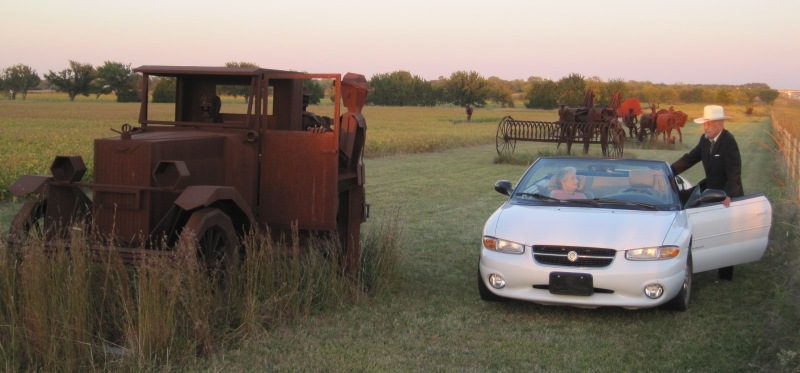
“the Hill” with its barn and trailer house so I could have a place
to work without disturbing my city neighbors. A place that Thomas
Gray describes in his Elegy – “Far from
the maddening crowds ignoble strife.” I named this place Henry's
Sculpture Hill in homage to Henry David Thoreau who wrote in
Walden: "If a man does not keep pace with his companions,
perhaps it is because he hears a different drummer."
Gradually, my teaching experiences directed me to literary subjects.
Fifty of the scenes and sculptures are based on classical literature
from Cervantes to Frost. Most high school
anthologies of literature have excellent pictures of art that
follows the chronology of the literature. I have been fortunate
enough to have my sculpture of William Carlos Williams’ “Red
Wheelbarrow” pictured in two American literature anthologies:
Literature: American Literature, McDougal Little, 2008, p.829 and
Literature: The Reader’s Choice, American Literature, Glencoe, 2000,
p. 613. What are the odds of a high school English teacher having
pictures of his sculpture in a book for him to teach from? Recently
my steel portrait of Thoreau was featured in Mark W. Sullivan’s book
Picturing Thoreau in 2015, pp. 119-120. Over the years I have
sold more than 150 sculptures – many of them on public display. Some
of them are pictured in the “Elsewhere”
section of this website. I still have over 300 sculptures. Many can
be seen on this website or along U.S. Highway 400. Numerous people
see them from the highway. Often they send me kind email messages or
letters about them. Many want to buy them. I haven’t been as eager
to sell as I have been to make new sculptures. After all, a place
called Sculpture Hill should have sculptures.
|
|
|
© 2001 to 2016 Franklin L. Jensen All Rights Reserved. All Original Works Property of Franklin L. Jensen |